A dealer’s maximum thickness, machine price, and warranty period do not show whether the equipment will produce acceptable parts at your required rate. You will be able to compare cutting processes, test real production conditions, verify installation and safety responsibilities, and calculate the service and operating risk before selecting a dealer.
Key takeaways
- Give every dealer the same thickness, material, tolerance and output brief.
- Choose plasma, laser, oxy-fuel or saw cutting by the actual job.
- Demand a witnessed cutting trial using your material and target edge quality.
- Compare utilities, installation, safety, consumables and downtime support—not machine price alone.
Define the Production Requirement Before Comparing Dealers
Give every dealer the same production brief before you compare prices or machine sizes. A maximum thickness figure is not a production requirement: a machine that pierces 40 mm plate may not repeatedly cut 25 mm plate to your required edge quality.
1. Name the material grade, condition, and thickness range. Specify whether the work includes mild steel, stainless steel, aluminium, high-strength steel, painted stock, or galvanised material; grade changes affect cutting parameters, heat input, dross, and consumable wear.
2. Record the maximum section size, including the largest plate, bar, angle, channel, beam, or other section. Add tube and profile sizes, wall thicknesses, outside dimensions, and the shortest finished length. A dealer cannot size loading equipment or fixturing from thickness alone.
3. State cut quality as a measurable target. Define the required cut tolerance and variability by ISO 9013 class, including perpendicularity or angularity, surface roughness, and nominal size tolerance. Also record acceptable burr, dross, heat-affected zone, kerf variation, and allowable rework.
4. Give production volume in parts, metres, or tonnes per shift, then separate batch size from total monthly demand. Include daily operating hours, changeover frequency, loading method, and the target production rate. A fast machine loses its advantage if small batches create long setup times.
5. Attach representative drawings and identify holes, slots, mitres, bevels, and repeat features. Ask the dealer to recommend a system against this workload, not against the largest machine in the catalogue, and require any claimed capacity to be demonstrated on your material.
Compare Cutting Processes Against the Actual Job
Start with the finished cut, not the machine’s maximum capacity. Compare each option on the same material grade, section size, tolerance, batch size, and daily hours; a process that looks cheap per cut can lose time through setup, cleanup, or rejected parts.
| Process | Best fit | Main trade-off to verify |
|---|---|---|
| Bandsaw | Straight cuts in bars, tubes, and structural sections | Slow corner changes; check blade life, squareness, burrs, and continuous cutting thickness |
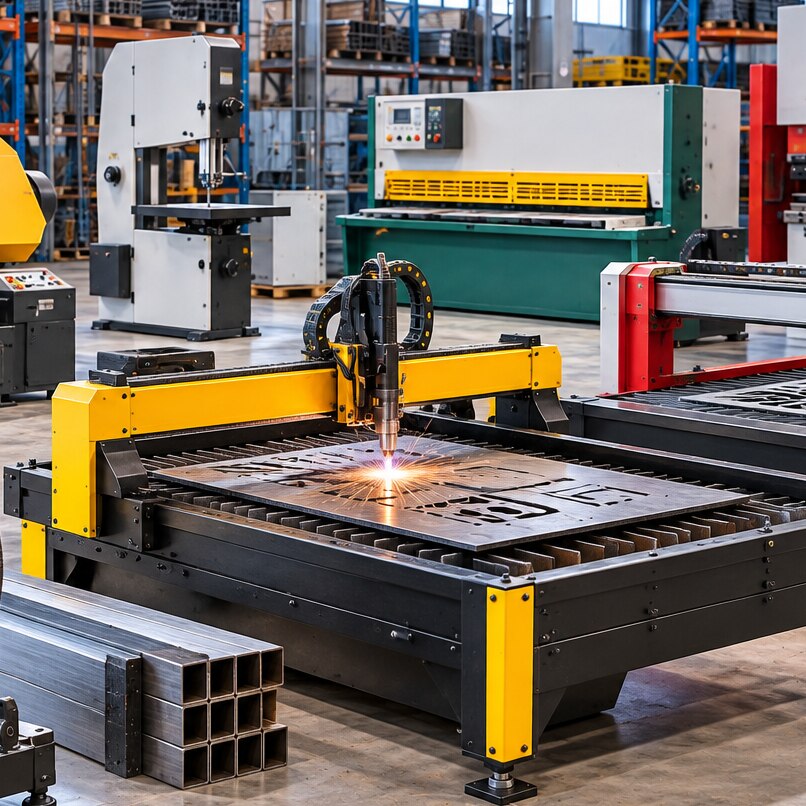
| Plasma cutting machine | Fast profiles in carbon and stainless steel sheet or plate | Produces a heat-affected zone and dross; measure kerf width, bevel, consumable life, and cut tolerance |
| Oxy-fuel cutting | Thick carbon-steel plate and repeated rough profiles | Slow piercing and unsuitable for stainless steel or aluminium; check heat distortion and edge cleanup |
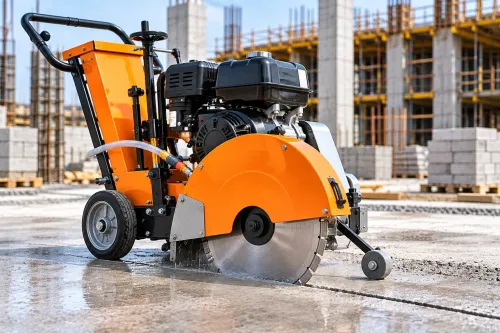
| Abrasive cutting | Clean, cold cuts on small sections, rods, and hard alloys | Generates discs, sparks, noise, and waste; compare cut speed, burrs, and operator time |
| Hydraulic cutting | Straight shearing of sheet, strip, or plate | Limited to suitable thickness and geometry; check edge deformation, squareness, and back-gauge repeatability |
| Manual cutting | Low-volume work, repairs, and irregular one-off pieces | Lowest automation; labour and inconsistent accuracy increase with batch size |
| Automatic cutting | Repeated parts and production batches | Higher setup and programming demand; verify nesting, remnant handling, and repeatability |
For the same drawing, record cycle time, scrap rate, kerf width, heat-affected zone, dross, burrs, and finished dimensions. Choose manual cutting only when flexibility outweighs labour; choose automatic cutting when repeatability and throughput pay back the setup. A witnessed test is stronger than a catalogue thickness claim.
Make the Dealer Prove Performance With Your Material
Require a witnessed sample test using your actual steel grade, thickness, profiles, drawings, and material certificate. Agree the cutting parameters, target cycle time, and acceptance measurements before the demonstration; a dealer’s catalogue thickness does not prove production capability.
- Cut the agreed test pieces and record ISO 9013 class, squareness, perpendicularity or angularity tolerance, mean roughness, dross, burrs, kerf width, and heat-affected zone.
- Check positional accuracy and repeatability across repeated parts, not just one attractive sample.
- Record piercing success rate, cycle time, scrap rate, and the number of parts needing rework.
- Run the test at your required production rate and batch size; a slow demonstration can hide an unworkable process.
- Reject results that meet appearance expectations but miss the agreed drawing dimensions or allowable rework limit.
Test the controller with your native CAD files, not dealer-prepared samples. Ask the operator to show nesting software, revision control, job-tracking or barcode data, and postprocessor handling for lead-ins, tabs, bevels, kerf compensation, and remnant handling.
For laser equipment, record beam configuration, assist-gas type and pressure, nozzle condition, and focal setting with the result. For a used machine, inspect controller history, source or torch hours, alignment records, and the documented test cut before accepting its stated capacity.
Audit Utilities, Safety, Installation, and Total Operating Cost
“Shop air” is not a utility specification. Require compressed-air pressure at the machine inlet, flow at that pressure, dew point, oil content, and particulate class against ISO 8573-1; poor air quality damages valves and plasma consumables.
Confirm the quotation includes:
- blade speed, feed control, plasma amperage, torch height control, coolant, chiller, fume extraction, ventilation, and stated electrical load
- foundation, leveling, floor space, crane access, earthing, gas plumbing, voltage conditioning, and operator training
- consumable life by material, amperage, gas, and cut mode, rather than unit price alone
| Audit area | Evidence to request | What failure reveals |
|---|---|---|
| Safety | ISO 12100 risk assessment for the complete cell; ISO 13849-1 performance level; IEC 60204-1 electrical file; IEC 60825-1 laser class and interlocks | Uncontrolled loading, guarding, electrical, or laser hazards |
| Utilities | Measured pressure and flow, gas consumption, air dew point, oil content, and filtration class | Commissioning delays or unstable cuts |
| Installation | Signed responsibility matrix for foundation, extraction, chiller, earthing, plumbing, and training | Disputed warranty work and idle equipment |
Calculate cost per accepted metre or part across your actual production mix. Include electricity, assist gas, consumables, extraction filters, coolant and chiller maintenance, software subscriptions, preventive maintenance, scrap, downtime, and operator labour. A faster machine can cost less overall if it produces fewer rejected parts, even with higher energy or consumable use.
Ask the dealer to show the assumptions and replace catalogue estimates with your demonstration results.
Select the Dealer That Can Protect Uptime After Delivery
Treat uptime as a contract deliverable, not a sales promise. Require the quotation to assign installation and commissioning, including foundations, leveling, extraction, chillers, voltage conditioning, grounding, gas plumbing, compressed-air treatment, crane access, and operator training. These interfaces often cause delayed start-up and warranty disputes.
Before choosing a dealer, obtain written answers to these service questions:
- What are the remote-response time and on-site response time for a breakdown at your Nagpur plant or another Indian site?
- What technician availability and service territory cover your location?
- What is the escalation process if the first technician cannot restore production?
- Where is the critical-spares stock, and what guaranteed parts availability applies to controllers, drives, sensors, torches, and power components?
- Which warranty exclusions cover consumables, operator damage, installation faults, utilities, and missed preventive maintenance?
Request the EU Declaration of Conformity, technical documentation, operating instructions in the required language, and safety-circuit evidence under ISO 13849-1 and IEC 60204-1. For a laser, record its class and inspect the enclosure, interlocks, maintenance access, and bypass prevention; CE marking alone is not third-party certification.
For used or refurbished equipment, demand controller history, drive history, source or torch hours, alignment and backlash records, software-support status, and a documented test cut. Reliable Impex, for example, should be evaluated by these service records rather than catalogue capacity or warranty length.
Related products
 | Band Saw Machine Metal Cutting Band Saw Machines Minimum Order Quantity 2 Piece Usage/Application Metal Cutting Material Steel Automation Grade Manual Cutting Capacity 200 mm (Round) and 220 x 200... View product → |
 | Cnc Plasma Pipe & Profile Cutting Machines Portable Cnc Plasma Cutting Machine Minimum Order Quantity 2 Piece Cutting Thickness More Than 30 mm Automation Grade Fully-automatic Power 1kv Voltage 415 V Material Stainless Steel... View product → |
Frequently asked questions
What production details should you give every cutting machine dealer?
Provide material grade, thickness range, sheet or plate dimensions, cut length, tolerance, edge-quality target, daily output, nesting needs and operating hours.
How do you choose between plasma, laser, oxy-fuel and saw cutting?
Match the process to material, thickness, tolerance, heat-affected zone limits, cut geometry, production volume and acceptable consumable cost.
Why should a dealer test the machine with your material?
A material trial verifies piercing, cut speed, kerf, dross, bevel, heat distortion and repeatability against your real production requirements.
What should you check beyond the cutting machine’s purchase price?
Check power, gas, extraction, floor space, operator safety, installation, training, consumables, maintenance response and the cost of production downtime.
Related product
 | Hydraulic Bar Cutter Machine Cutting Disc Size 5 inch Machine Type Portable Weight 400kgs Warranty 1 year Material Steel Automation Grade Automatic Voltage 415V Steel bar cutting... View product → |