
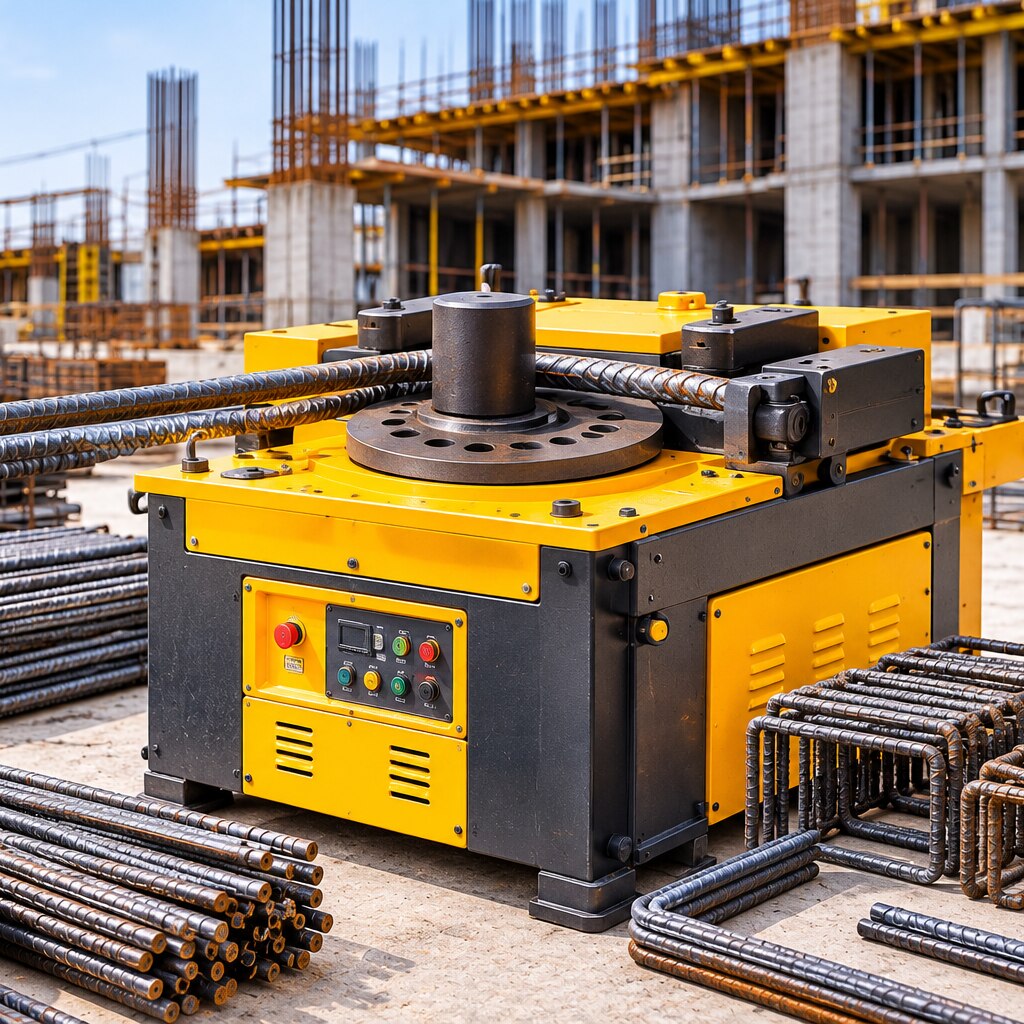
A machine’s advertised maximum bar diameter tells you little about its real production capability. You need to match the equipment to your reinforcement schedule, test it with your own steel, and compare the supplier’s documentation, safety controls, installation support, and service commitments before signing an order.
Key takeaways
- Build capacity requirements from bar diameter, grade, bend angle, and daily quantity.
- Choose single-bar, multi-bar, stirrup, or coil-fed equipment for the work mix.
- Run bending trials using your own steel before approving the machine.
- Demand manuals, safety documentation, commissioning terms, and response times in writing.
Start With the Reinforcement Schedule, Not the Advertised Diameter
Select the machine from the reinforcement schedule: list each bar diameter, bar grade and yield strength, bend angle, inside bend diameter, bars per batch, daily quantity, and required cycle time. That schedule determines the bar bending machine capacity you need. The advertised maximum bar diameter is only a starting point.
| Schedule pattern | Suitable category | Capacity evidence to demand |
|---|---|---|
| One bar at a time, varied shapes | Single-bar bender | Rated torque and cycle time for each routine diameter |
| Repeated heavy batches | Multi-bar bender | Maximum bars per batch at the specified grade and bend |
| Links and stirrups with repeated dimensions | Stirrup or link bender | Straightness, programmable dimensions, and changeover time |
| High-volume straight stock from coils | Coil-fed machine | Feed accuracy, cutting capacity, and sustained output |
Ask for a capacity table covering your exact combination of diameter, bar grade and yield strength, bend angle, inside bend diameter, and simultaneous bars. High-yield-strength reinforcement can reduce the stated diameter, slow the cycle, or cut the number of bars bent together.
The required inside bend diameter comes from the governing reinforcement or structural-design standard, not from the tightest bend the machine can physically make.
Check whether the rating supports continuous industrial duty or only occasional bending. Obtain motor and gearbox ratings, overload protection, thermal limits, and the rated cycle time.
Then require a factory test using your largest routine bar, highest-strength grade, hardest bend sequence, and full batch size; record accuracy, repeatability, jams, rejected pieces, cycle time, and operator interventions.
Separate Single-Bar, Multi-Bar, Stirrup, and Coil-Fed Machines
Choose the format by bar shape, batch size, changeover frequency, and handling space—not by the largest diameter in the brochure.
| Format | Best fit | Main trade-off |
|---|---|---|
| Single-bar bender | Occasional straight-bar bends, varied diameters, and frequent recipe changes | Flexible, but loading each bar limits throughput and demands clear infeed and discharge space |
| Multi-bar bender | Repeating bends on several identical straight bars | High batch output, but mixed diameters require tooling or setting changes and parallel bars need separation space |
| Stirrup bending machine | Links, closed stirrups, and repetitive rectangular or shaped cages | Fast, repeatable production, but less suitable for long, irregular bars |
| Coil-fed bar bending machine | High-volume links and continuous shapes from coiled steel | Excellent automation and low piece handling, but requires decoiling, straightening, coil storage, and a longer guarded line |
Do not compare bars per minute across these formats as if the figures describe the same work. A multi-bar bender’s rate depends on the number of bars loaded, while a coil-fed bar bending machine also includes straightening and cutting steps.
Ask for output using your actual bar grade, diameter, bend angle, inside bend diameter, batch size, and duty cycle.
Measure the complete working envelope before accepting a quoted footprint. Confirm:
- Three-phase supply, protection, compressed-air needs, and floor anchoring
- Forklift or crane access for installation and maintenance
- Straight-bar storage, safe loading length, discharge clearance, and separation space
- Mandrels, rollers, pins, guide parts, changeover time, wear life, and replacement prices
A machine that fits the floor plan can still fail if operators cannot load or discharge bars without crossing the next cycle.
Prove Bending Quality With Your Own Steel
A bar bending machine demonstration proves nothing if it uses the supplier’s easy-to-bend stock. Bring your own reinforcement and make the test represent production: the largest routine bar, highest-strength grade, most demanding bend sequence, and required number of bars per batch.
1. Confirm the capacity claim against the exact combination of bar diameter, yield strength, bend angle, inside bend diameter, simultaneous bars, and duty cycle. Require the supplier’s capacity table; reject a single “maximum diameter” figure.
2. Run the actual shapes and inspect sample bends against your drawing tolerances. Measure leg lengths, angles, stirrup dimensions, and the inside bend diameter. The smallest radius the machine can physically form is irrelevant if it damages the bar or violates the governing reinforcement standard.
3. Record springback after each required angle, then check repeatability across a full batch. A machine that produces one accurate bend but drifts as tooling heats or stock changes is not production-ready.
4. Time the complete cycle, including loading, repositioning, and unloading. Record jams, rejected pieces, alarms, manual corrections, and operator interventions rather than reporting only successful bends.
5. Put the acceptance criteria in writing before the factory-acceptance test. Require the signed test record, photographs or measured results for the sample bends, and a remedy—rework, replacement, or payment hold—if the machine misses capacity, accuracy, repeatability, or cycle-time targets. Witness the same checks again after installation.
Audit the Machine, Tooling, Controls, and Safety Design
A quoted maximum diameter proves little unless the supplier states the duty-cycle basis behind it. Ask for continuous and intermittent ratings, motor and gearbox quality, overload protection, thermal limits, and rated cycles per hour.
A drive sized for occasional bending will overheat, lose repeatability, or trip during production even when its headline capacity matches your schedule.
| Audit point | Evidence to request | Warning sign |
|---|---|---|
| Drive system | Motor rating, gearbox make and service factor, thermal class, overload setting, duty cycle | “Heavy duty” without test conditions or cycle data |
| Bending machine tooling | Mandrels, rollers, pins, and guides listed by bar-size range, wear life, replacement price, and changeover time | One generic tool claimed to cover every diameter |
| Control panel design | IEC 60204-1 edition, emergency-stop circuit, guarded restart logic, recipe backup, access levels, revision history, and power-loss recovery | Attractive touchscreen with no safety-circuit validation evidence |
| Machine structure | Frame, rotating table, bearings, shaft sizes, anchoring method, and discharge arrangement specified | Capacity stated without repeatability or alignment limits |
| Safety design | ISO 12100 risk assessment covering entanglement and crush points at the table, tools, feed, and discharge | Warning labels used instead of interlocked guards or engineered prevention |
Check that the machine remains safe and usable without internet access or remote diagnostics. If it will be placed on the European market, request the Declaration of Conformity, technical file references, risk assessment, and required-language instructions; a CE mark alone is not sufficient.
Ask who supplies replacement tooling and electrical components, and record each part number before signing.
Compare the Supplier’s Documents, Commissioning, and Service Promise
Require dates, deliverables, and remedies in the purchase order, not assurances in a sales call. Whether you are assessing RELIABLE IMPEX or another bar bending machine supplier, demand a technical datasheet, general arrangement drawing, and complete electrical file before release of payment.
| Document | Written commitment to obtain | How you measure it |
|---|---|---|
| Technical file | Capacity by bar grade and diameter, duty cycle, motor and gearbox ratings, supply-voltage tolerance, wiring diagrams, component part numbers, fault codes, PLC backup method, and tooling prices | Compare the stated limits with your reinforcement schedule and spare-parts plan |
| Installation | Delivery scope, foundation and lifting requirements, utilities, assembly date, calibration method, operator training hours, and commissioning records | Sign only after the machine passes recorded test bends using your steel |
| Acceptance | Sample bar sizes, angles, radii, cycle time, repeatability tolerance, safety checks, and the remedy for failure | Require repair, replacement, or payment retention until every agreed result is met |
| Service | Remote and on-site response times, escalation contacts, critical-spares availability, and operation without internet diagnostics | Record the clock from your logged breakdown to technical response and restoration |
| Warranty and after-sales service | Coverage for motors, controls, tooling, wear parts, labour, travel, and software faults, with exclusions stated | Reject a warranty that covers the machine but leaves tooling or commissioning failures undefined |
Also require these production-recovery details:
- Recipe export, revision control, password levels, multilingual manuals, and power-loss recovery instructions.
- A named service manager, parts lead time, and substitute part procedure for proprietary components.
- A written training sign-off covering setup, safe changeover, fault resets, and daily inspection.
Frequently asked questions
Why should you start with the reinforcement schedule instead of advertised diameter?
The schedule identifies bar diameters, grades, yield strengths, bend angles, inside bend diameters, batch sizes, daily quantities, and cycle times. Those details determine machine capacity more accurately than the maximum advertised diameter.
How do single-bar, multi-bar, stirrup, and coil-fed machines differ?
Single-bar machines process individual bars, while multi-bar machines bend several bars in one batch. Stirrup machines focus on repeated closed shapes, and coil-fed machines straighten and bend material supplied from a coil. Match the machine type to your bar sizes, shapes, volume, and production flow.
What should you test with your own reinforcement steel?
Test every important diameter and grade at the required bend angles and inside bend diameters. Check finished dimensions, repeatability, surface damage, cracking, cycle time, and performance across a realistic production batch.
Which machine, tooling, control, and safety features deserve an audit?
Inspect the frame, drive system, bending table, pins, rollers, guards, emergency stops, control panel, angle setting, overload protection, and access to replacement tooling. Confirm that the design suits your bar sizes and working conditions.
What supplier documents and service commitments should you compare?
Request the technical datasheet, operating manual, electrical drawings, maintenance schedule, tooling list, warranty terms, commissioning scope, operator training details, spare-parts process, and stated service response times.


