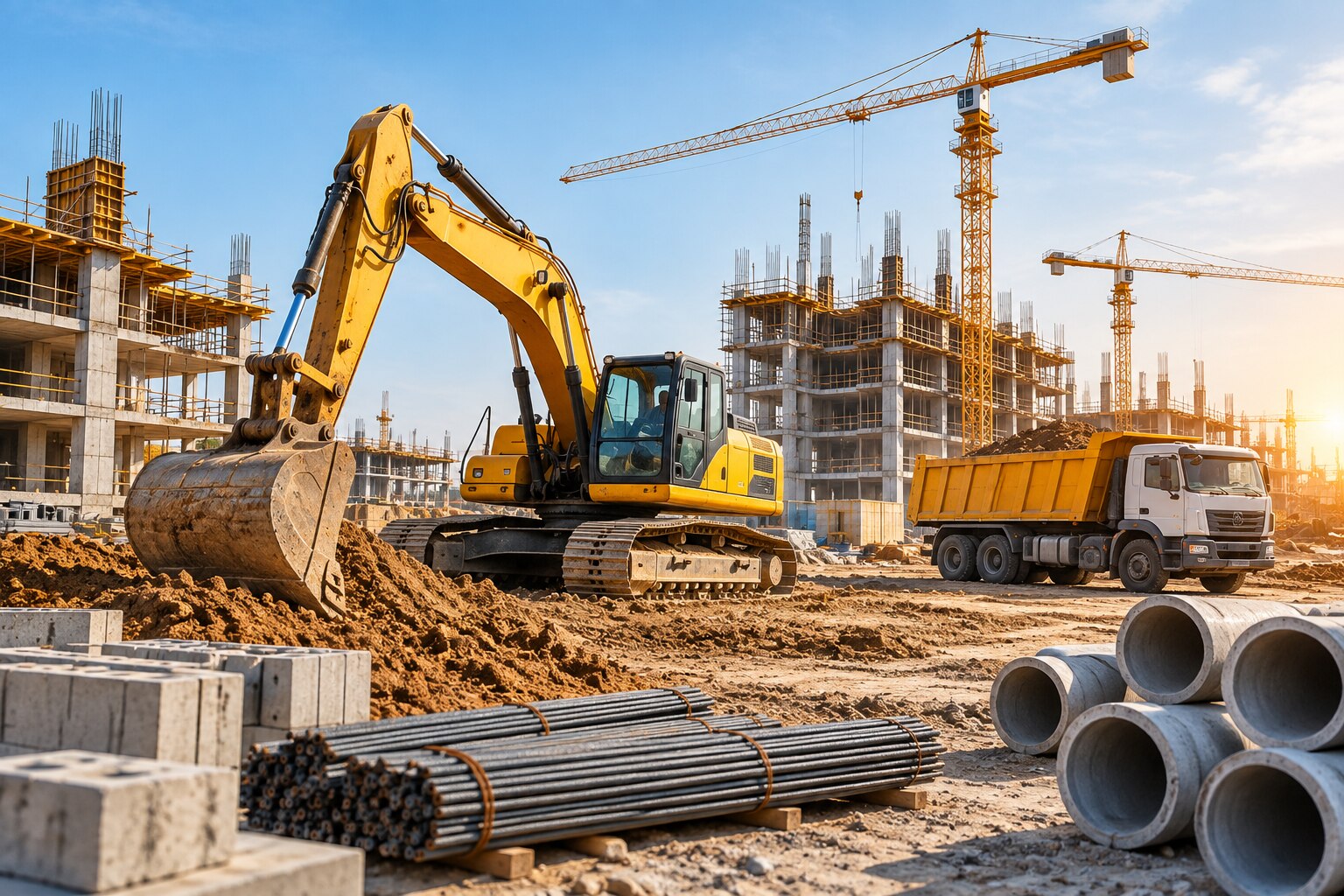
A building project loses time when equipment is chosen by headline capacity instead of the work, access, ground conditions, and production sequence. By matching each machine to its duty, verifying site interfaces, and defining acceptance documents before delivery, you can support both a small building site and a large infrastructure programme without paying for unusable capacity.
Key takeaways
- Assign each machine to a defined work package before ordering.
- Check ground conditions, access, and power supply before selecting equipment.
- Calculate usable crane capacity at the required radius and lift height.
- Include operating records, inspections, and training in project handover.
Match Equipment to Each Building Work Package
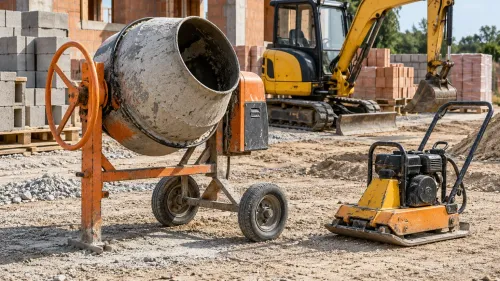
Site preparation equipment starts the project: use compactors, graders, loaders, excavators, and water bowsers to clear ground, shape levels, and prepare sub-base. Match each package to the work and scale rather than ordering one machine for every task.
| Work package | Small building project | Large building project |
|---|---|---|
| Site preparation | Mini excavator, skid-steer loader, plate compactor | Excavator, wheel loader, grader, and vibratory roller |
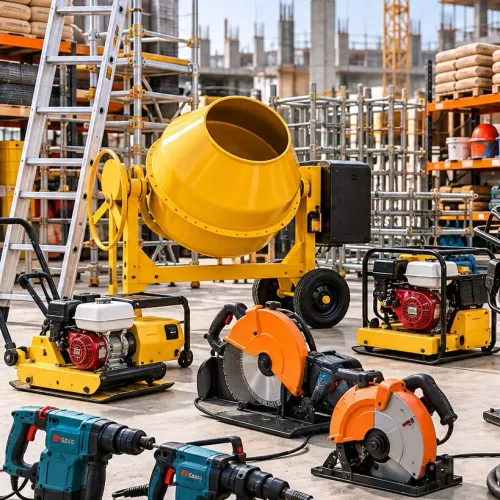
| Concrete work | Mixer, poker vibrator, screed, and concrete finishing equipment | Batching plant, pump, laser screed, power float, and ride-on trowel |
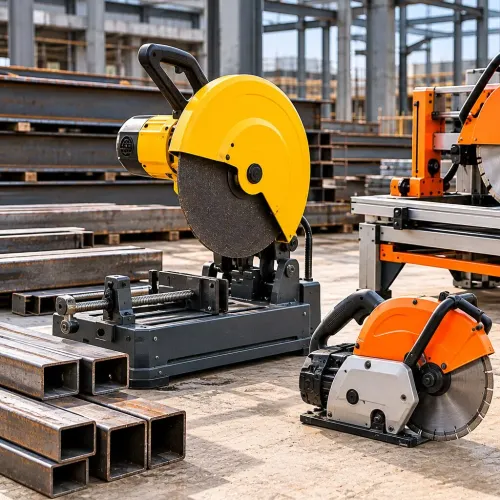
| Structural steel | Portable saw, drill, welding set, and small forklift | Fabrication line, cranes, approved lifting gear, and transport frames |
| Lifting | Material hoist, telehandler, or manual handling for light loads | Mobile crane, tower crane, telehandler, or gantry matched to load charts |
| Roadwork | Walk-behind roller, plate compactor, cutter, and small paver | Grader, pneumatic or vibratory roller, asphalt paver, and water tanker |
| Reinforcement cutting | Bar cutter and bar bender sized for scheduled diameters | High-throughput cutter, bender, shear line, and bundling equipment |
For small building projects, modular machines reduce commissioning and spare-parts demands only when access width, power, foundations, and material flow fit. For large building projects, construction equipment supply must include delivery sequencing, route surveys, permits, temporary works, storage, and installation—not merely a dispatch date.
Ask for foundation loads, anchor locations, voltage, fault level, air and water demand, dust extraction, maintenance clearance, and control-network details. For structural steel, an EN 10204 Type 3.1 certificate proves material identity and test results; it does not prove fabrication, welding, tolerances, coating, or traceability compliance.
Select Machines by Conditions, Not Project Size Alone
Choose equipment by the work conditions it must survive, not by project value or building size. Start with the heaviest load, its dimensions, required lift height, working radius, lifting accessories, duty cycle, and the number of cycles per hour.
| Condition | Check before ordering | What can go wrong |
|---|---|---|
| Load and geometry | Use the manufacturer’s load chart for the exact boom, span, radius, attachments, and outrigger position | A headline capacity can exceed usable capacity at full reach |
| Ground and pavement | Confirm soil type, pavement thickness, slope, and ground bearing capacity under wheels, outriggers, or stabilisers | Settlement can tilt a crane or crack a finished slab |
| Space and access | Measure access width, turning space, slab area, overhead clearance, and material route | A suitable machine can arrive but fail to reach the workface |
| Material and process | Record steel lengths, reinforcement diameter, concrete volume, aggregate size, and required cycle time | The machine stalls, overloads, or leaves production waiting |
| Utilities and programme | Confirm power availability, fuel access, setup time, delivery date, and removal date | A low-cost machine creates delays through rewiring or late mobilisation |
For lifting equipment, require the applicable load chart, wind limit, support requirements, inspection records, operator qualification, and manufacturer operating procedure. OSHA 29 CFR 1926.1417 requires crane operations to follow manufacturer procedures and safe-load information.
Before ordering, record these four figures in the specification:
- Maximum load including slings, forks, buckets, and spreader beams.
- Maximum radius and lift height at the actual setup point.
- Narrowest access width and weakest supporting surface.
- Required output, available power, and date the machine must be productive.
Calculate Usable Lifting Capacity Before Choosing a Crane
A 5-ton rating covers your lift only when the manufacturer’s load chart shows at least 5 tons at the planned radius, boom length, height, support arrangement, and wind limit. The headline rating usually applies to a specific configuration, not every position.
| Equipment | Best fit | Main limitation |
|---|---|---|
| Manual labour | Light, compact items moved short distances at floor level | Slow, unsafe for suspended or awkward loads |
| Hoist | Repeated vertical lifting through a fixed opening or shaft | Needs a certified support point and controlled travel |
| Forklift | Palletised loads on firm, level ground | Poor choice for high or offset lifts |
| Telehandler | Pallets and materials across uneven ground or over obstacles | Capacity falls sharply as reach increases |
| Mini crane | Confined sites, interior work, and precise lifts | Limited radius and setup capacity |
| Mobile crane | Heavy loads at greater height or radius | Requires access, outrigger space, ground checks, operator, and lifting plan |
For hoist selection or crane selection, weigh the load together with slings, shackles, spreader beams, hooks, and packaging. Then check that total against the load chart at the exact working radius and height; include the manufacturer’s allowance for dynamic loading, wind, and duty cycle.
A 5-ton crane passes only if that chart value still exceeds the complete lifted weight under the planned configuration.
Confirm ground-bearing capacity beneath outriggers, the machine’s inspection records, operator requirements, and the manufacturer’s operating procedure. If the chart does not cover the planned geometry, choose a larger machine or reduce the radius; never treat a later test lift as proof of safe capacity.
Coordinate Concrete Finishing and Compaction With Site Conditions
Run the power floater after concrete bleed water has disappeared from the surface and the slab supports the machine without deep tracking. Floating too early traps water near the top, weakens the surface, and increases dusting; waiting too long leaves ridges that blades cannot remove.
Use a pan for the first pass on stiff concrete, then blades for densifying and closing the surface.
Choose compaction equipment by working room, layer thickness, and nearby structures rather than roller size alone.
| Application | Preferred equipment | Site decision |
|---|---|---|
| Open soil or sub-base | Large vibratory roller | Covers wide areas quickly and delivers deeper compaction; verify lift thickness and soil moisture before vibrating. |
| Asphalt pavement | Large vibratory roller | Suits continuous lanes and broad parking areas; match vibration, speed, and passes to the asphalt temperature window. |
| Utility trenches | Walk-behind roller | Fits between walls and around services; compact in thin lifts and keep vibration away from exposed pipes and foundations. |
| Footpaths and small plots | Walk-behind roller | Turns in confined spaces and avoids the access, setup, and edge damage caused by a larger machine. |
A large vibratory roller loses its advantage when it cannot turn, reach the edge, or travel safely over weak ground. A walk-behind roller takes longer on a road or foundation pad, but it reduces handwork around kerbs, columns, trench boxes, and drainage covers.
Check the roller’s drum width, operating weight, vibration frequency, and clearance before delivery. After rain, test moisture and density rather than adding passes blindly; vibration cannot correct saturated soil.
Make Equipment Supply Part of Commissioning and Handover
A delivery date is not an installed-and-commissioned date. For oversized machines, fabricated frames, silos, tanks, or long steel members, confirm the route survey, transport permits, escort vehicles, lifting plan, temporary works, unloading area, and protected storage before dispatch.
Freeze the machine interfaces before the foundation is built. The supplier must provide:
- Foundation loads, anchor locations, installation clearances, and maintenance access
- Voltage, phase, fault level, cable size, and earthing requirements
- Compressed-air, water, dust-extraction, and drainage demand
- Control-network protocol, software version, and parameter backup
Run factory acceptance testing against agreed production criteria, not an empty-machine demonstration. Record throughput, dimensional accuracy, cycle time, reject rate, noise, energy consumption, and safe-stop performance, then repeat the relevant checks during site acceptance testing with the project’s material, utilities, and operators.
Machine guarding belongs in the handover package. Check point-of-operation guards, interlocked doors, emergency stops, nip-point protection, rotating-part covers, and protection from chips or sparks before authorising production.
For handover, obtain manuals, assembly and electrical drawings, wiring diagrams, lubrication schedules, certificates, calibration records, recommended spare parts, software backups, and declared exclusions. Ask for replacement lead times and service contacts. A traded machine from RELIABLE IMPEX is easier to maintain when these records arrive with it, rather than after a breakdown.
Close the package with operator training, inspection sheets, test results, warranty terms, and a signed punch list. Standardized equipment reduces commissioning effort on small sites only when its footprint, power supply, access route, foundation, and material flow already fit.
Related products
 | Mini Crane Capacity 5 Ton Max Height 10 Feet Span 20 m AMC/After Sales Service Provided Power Source Electric Hoist Travelling Speed 0-5 m/min Established in... View product → |
 | Power Floater roduct Details: Engine Power 35 Hp Material Power Trowel Color Blue And Black Automation Grade Semi Automatic Usage/Application For Construction Is... View product → |
Frequently asked questions
How do you match construction equipment to each building work package?
List the activities, output targets, access limits, and sequence for each package, then assign machines such as excavators, loaders, compactors, graders, or concrete equipment to those specific tasks.
Why should site conditions matter more than project size when selecting machines?
Ground bearing capacity, slope, access width, working clearance, soil moisture, power availability, and transport constraints determine whether a machine can work safely and productively.
How do you calculate usable lifting capacity before choosing a crane?
Check the crane load chart at the planned boom length, working radius, lift height, outrigger setup, and counterweight configuration, then subtract the weights of slings, spreader beams, hooks, and other lifting gear.
What equipment information belongs in construction commissioning and handover?
Provide inspection certificates, manuals, maintenance schedules, operating procedures, spare-parts details, training records, and a list of outstanding defects or restrictions.
Related products
 | Roller Machine Product Details: Automation Grade Semi Automatic Engine Power 110 HP @ 2200 rpm Rolling Width 1250 mm, 1675 mm Warranty 18 Months Vibration Frequency... View product → |
 | Walk Behind Roller Minimum Order Quantity 5 Piece Engine Power 5 HP Drive type Manual Rolling Width 1675 mm, 1250 mm Max Roll Weight 330 Kg Approx. View product → |
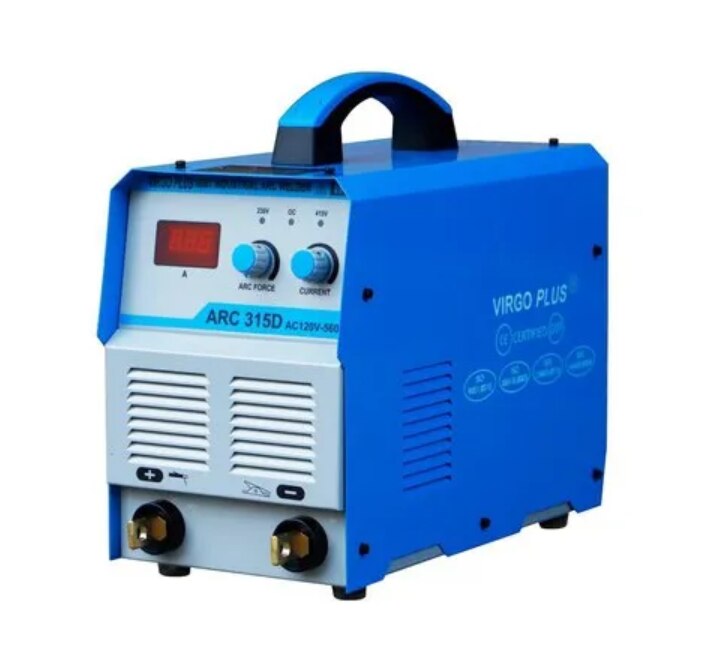 | Welding Machine Minimum Order Quantity 2 Piece Phase Single Welding Type Arc Brand Esab Model 315 AP Insulation A Compatible Rods 8 mm Established in the year 2020... View product → |
 | Hydraulic Bar Cutter Machine Cutting Disc Size 5 inch Machine Type Portable Weight 400kgs Warranty 1 year Material Steel Automation Grade Automatic Voltage 415V Steel bar cutting... View product → |