The right cutting machine depends on more than maximum thickness or motor power: material, cross-section, tolerances, production rate, cut geometry, and site utilities all change the decision. By the end, you will be able to compare mechanical and thermal processes, challenge capacity claims, and specify the tests and operating details a supplier must provide.
Key takeaways
- Match the process to material, thickness, cross-section, volume, and tolerance.
- Compare cutting speed, heat-affected zones, burrs, noise, and consumable use.
- Treat capacity ratings as maximum geometry limits, not one universal thickness.
- Calculate utilities, maintenance, consumables, downtime, and operator needs before buying.
Match the cutting process to the material and job
Choose the process by material type, cross-section, thickness, production volume, and required tolerance—not by maximum machine capacity alone. Plate cutting machine selection changes sharply between carbon steel, stainless steel, and aluminium.
| Material | Suitable process | Why it fits |
|---|---|---|
| Reinforcing bar | Hydraulic bar cutter | Fast, cold cuts for repetitive bar lengths; not suited to plate or precise angled profiles. |
| Structural sections | Band saw or cold saw | Handles beams, channels, angles, and hollow sections with controlled burrs; cold saws suit high-volume repeat cuts. |
| Carbon-steel plate | Oxy-fuel, plasma, laser, or waterjet | Oxy-fuel suits thick carbon and low-alloy steel; plasma and laser suit faster profiles; waterjet avoids a heat-affected zone. |
| Pipe | Band saw, cold saw, laser, or plasma | Choose from wall thickness, diameter, volume, and whether you need square ends, notches, or cut-outs. |
| Stainless steel | Band saw, laser, plasma, or waterjet | Avoid oxy-fuel; waterjet prevents heat damage, while laser gives clean profiles when thickness and reflectivity remain within process limits. |
| Aluminium | Cold saw, laser, plasma, or waterjet | Cold sawing suits straight production cuts; waterjet avoids thermal distortion, and laser needs suitable settings for reflective surfaces. |
| Wire | Mechanical wire cutter or straightener-cutter | Best for repeated lengths and high volume; use a precision process only when dimensional or end-finish demands justify it. |
For plate and structural work, test piercing separately from edge cutting. Thick plate can cut from an existing edge yet fail at a programmed start point; small holes and narrow slots reveal heat, kerf, dross, and roundness problems sooner than long straight cuts.
Compare speed, heat, burrs, noise, and consumables
Rated speed does not equal lowest cost. Calculate cost per acceptable part or metre, including blades, wheels, electrodes, nozzles, abrasive, gases, coolant, labour, finishing, and scrap.
| Process | Speed and heat | Burrs, noise, and consumables | Real operating cost and cut quality |
|---|---|---|---|
| Hydraulic bar cutter | Very fast for reinforcing bar; negligible heat | Quiet, no sparks; blades need sharpening or replacement | Low cost per bar when cutting high volumes; cut ends can deform |
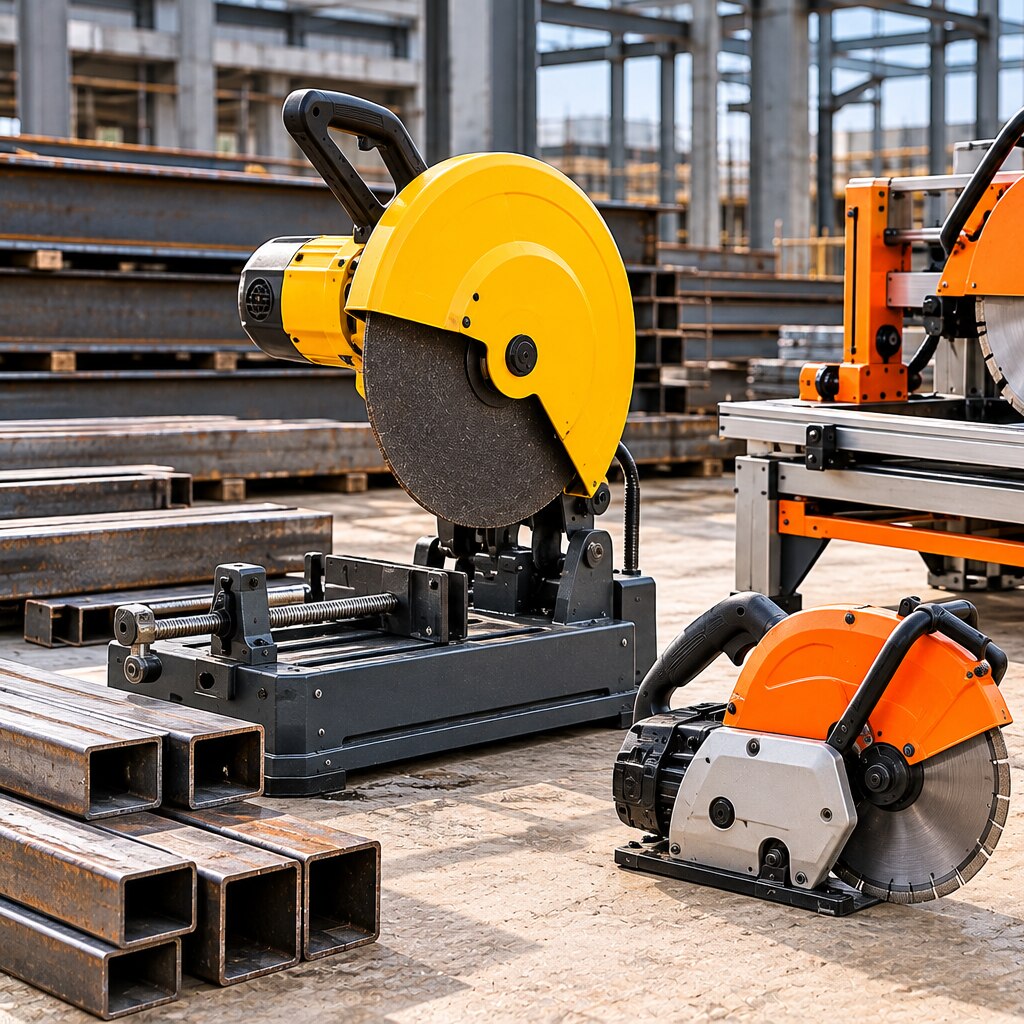
| Abrasive chop saw | Fast on individual steel cuts; high heat | Loud, dusty, sparks; wheels wear quickly and leave burrs | Low purchase cost, but wheel use, cleanup, and deburring raise cost |
| Cold saw | Fast on repeat straight cuts; low heat | Quieter and cleaner than abrasive cutting; carbide or HSS blades cost more | Narrow kerf, square cuts, and low burrs reward production work |
| Band saw | Steady, slower cutting; low heat | Low noise and narrow kerf; blade pitch, coolant, tension, and feed need control | A band saw comparison favours repeatability and low waste, not complex contours |
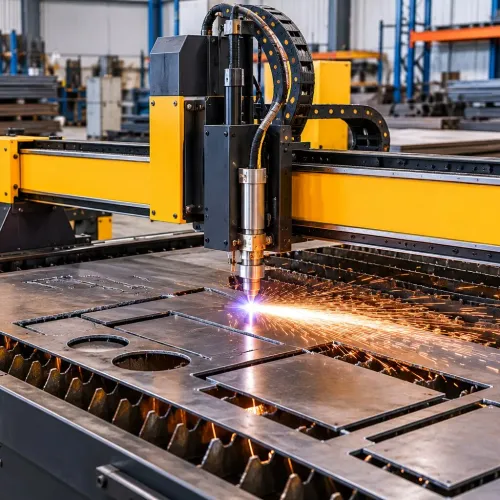
| Plasma cutter | Fast on conductive plate; heat-affected zone | Arc glare, fumes, dross, and noise; electrodes and nozzles wear | Low capital cost, but edge angle and finishing affect part cost |
| Waterjet | Slower on thick stock; no heat-affected zone | Very loud and wet; abrasive, orifice, mixing tube, and pump parts wear | Excellent for heat-sensitive materials, but water, abrasive, taper, and maintenance cost more |
| Laser | Fast and precise on suitable sheet; limited heat zone | Relatively clean edge; nozzles and protective optics require replacement | High capital cost, with excellent geometry and low finishing demand |
Specify ISO 9013 cut-quality class or measurable tolerances; “laser-cut” alone does not define the finished edge.
Read capacity figures as cutting geometry, not a single number
A capacity figure describes the opening and movement available for one specific cut geometry, not the maximum stock you can process in every orientation.
A band saw cutting capacity marked at 90-degree cut usually means the largest single piece the vise and blade can cut square across; it does not guarantee the same result at a 45-degree cut.
| Figure | What it means in production | What changes |
|---|---|---|
| Round capacity | Maximum outside diameter of solid round stock | The vise grip, blade pitch, material grade, and cut angle |
| Square capacity | Maximum side length of solid square stock | Corner contact, blade loading, and whether the stock is rotated |
| Rectangular capacity | Maximum width and height in the stated orientation | Turning the section can make one dimension exceed the throat or vise opening |
| Hollow-section capacity | Envelope size of tube, box section, or pipe | Wall thickness, unsupported faces, vibration, and blade tooth engagement |
| Bar diameter range | The smallest and largest bar diameters the machine can clamp and cut reliably | Feed accuracy, short offcuts, bundle stability, and minimum remnant length |
| Cut length | The length the automatic feed or stop can index in one cycle | Required repeatability, stock straightness, and how many re-grips the job needs |
At a 45-degree cut, the blade travels through more material than at 90 degrees, so the usable capacity usually falls and cutting time rises. Ask for capacities by grade, wall thickness, angle, and bundled quantity; a chart based on one mild-steel bar can mislead you on stainless tube or a bundle of reinforcement bars.
Test thermal cutters for production-quality parts
A cutter that severs 25 mm plate once may fail on the same plate at production speed. Verify performance on your actual production material and part geometry; maximum severance thickness is a limit, not a promise. Recommended production thickness is the figure to use for repeatable parts.
Request cut charts and sample parts that show:
- The material grades and thicknesses you will run, including stainless steel or aluminium if required.
- Piercing at the programmed start point, not only cutting from an existing edge. Thick plate may need ramped piercing, a sacrificial lead-in, or a pre-drilled start hole.
- Straight and contoured edges at the required feed rate.
- The smallest holes and slots in your drawings. Heat accumulation, kerf width, pierce location, and the feature-to-thickness ratio can produce oval holes, dross, or a vanished slot.
- Cycle time, consumable life, and parts per shift at the stated quality.
Write the acceptance standard into the purchase order. ISO 9013 defines thermal-cut surface quality classes and measurable tolerances for edge geometry and texture; “plasma-cut” alone says too little. Test the specified class on the specified material and thickness.
Treat fumes as a machine-selection issue. For a CNC plasma cutter, require local exhaust ventilation and confirm whether a water table or downdraft table suits your dross, noise, visibility, corrosion, and maintenance constraints. Verify airflow and filtration before commissioning.
Specify the machine, utilities, and ownership cost before buying
Before installation, obtain a written specification for power, gases, extraction, maintenance access, and acceptance tests. A machine that fits the material but trips the site supply, lacks clean compressed air, or fails small-hole tests becomes an expensive obstruction.
- Confirm the 415 V power supply, phase and current draw, recommended breaker size, earthing, cable size, isolation switch, and generator compatibility. Ask whether the stated current is continuous, peak, or includes the compressor and extraction system.
- Record gas type, inlet pressure, flow rate, hose connection, cylinder or manifold requirement, and purity. For plasma, confirm whether the machine uses shop air, oxygen, nitrogen, or a combination; for laser, specify the assist gas and its effect on edge oxidation and cost.
- Specify local exhaust ventilation, water-table or downdraft requirements, airflow, spark and fume handling, sludge removal, noise, and corrosion controls. OSHA treats cutting fumes as an exposure hazard, not a housekeeping issue.
- Request a maintenance schedule covering filters, torches, electrodes, nozzles, optics, pumps, blades, abrasive-delivery parts, lubrication, and alignment. Price each consumable and use cost per acceptable part or metre of cut.
| Item | Confirm at acceptance | Reject or correct if |
|---|---|---|
| Power and utilities | Actual voltage, current, gas pressure, and extraction performance under load | Trips, unstable arc, restricted flow, or visible fume escape |
| Cut quality | Supplier cuts your grade, thickness, contours, holes, slots, and required throughput | Dross, taper, roundness error, distortion, or unacceptable heat-affected edge |
| Documentation | Manuals, wiring diagram, spare-parts list, warranty, and service response | Missing settings or no defined support |
With a supplier such as RELIABLE IMPEX, put these tests and site requirements in the purchase order, not in a verbal promise.
Related products
 | Hydraulic Bar Cutter Machine Cutting Disc Size 5 inch Machine Type Portable Weight 400kgs Warranty 1 year Material Steel Automation Grade Automatic Voltage 415V Steel bar cutting... View product → |
 | Band Saw Machine Metal Cutting Band Saw Machines Minimum Order Quantity 2 Piece Usage/Application Metal Cutting Material Steel Automation Grade Manual Cutting Capacity 200 mm (Round) and 220 x 200... View product → |
Frequently asked questions
How do you choose a cutting process for construction and fabrication work?
Match the process to the material type, cross-section, thickness, production volume, and required tolerance. Carbon steel, stainless steel, and aluminium place different demands on the machine.
What should you compare besides cutting speed?
Compare heat input, heat-affected zones, burr formation, noise, consumable use, finish quality, cleanup time, and operating cost.
Why is a machine’s maximum capacity not enough for selection?
Capacity depends on cutting geometry, including plate thickness, tube diameter, profile shape, pierce limits, and the size of the working area.
How should you test a thermal cutting machine before purchase?
Cut representative production materials and inspect edge squareness, dross, burrs, heat distortion, hole quality, repeatability, and cleanup requirements.
Which machine and ownership costs should you specify before buying?
Specify the machine configuration, power and gas utilities, extraction, consumables, maintenance, operator requirements, downtime risks, and expected service needs.
Related product
 | Cnc Plasma Pipe & Profile Cutting Machines Portable Cnc Plasma Cutting Machine Minimum Order Quantity 2 Piece Cutting Thickness More Than 30 mm Automation Grade Fully-automatic Power 1kv Voltage 415 V Material Stainless Steel... View product → |