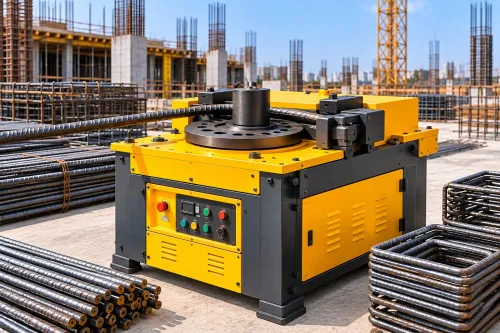
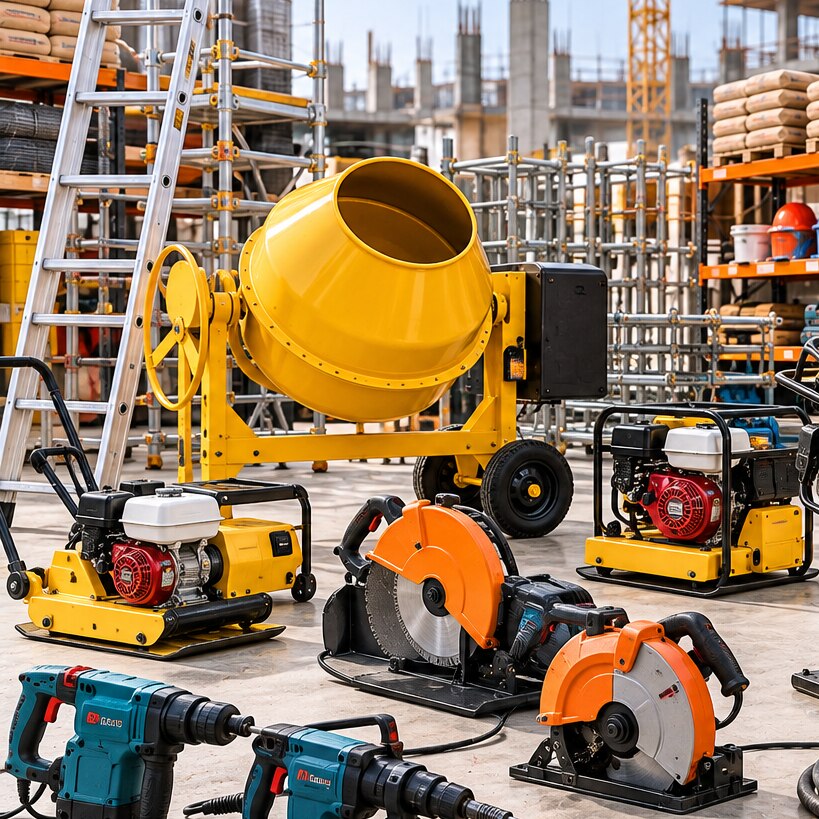
A project that combines lifting, cutting, welding, concrete finishing, and compaction creates more than a shopping list: each machine must fit the site, the power supply, the work sequence, and the others around it. You will be able to compare procurement routes, test catalogue claims against usable capacity, and select equipment by operating conditions rather than headline specifications.
Key takeaways
- Request one quotation with specifications, delivery dates and warranty terms.
- Choose capacity from your site’s actual load, space and power supply.
- Test access, fuel, voltage, ground conditions and operator requirements before ordering.
- Compare bundled service and delivery costs with separate specialist suppliers.
Why a single equipment source reduces procurement friction
When a project needs welding equipment, a generator, a compressor, lifting gear, and site tools, one construction tools and machines retailer gives you one commercial route instead of several disconnected orders. A multi-category equipment supplier can issue one quotation for construction equipment, align specifications, and provide one invoice and delivery schedule.
That coordination cuts avoidable chasing. You deal with one contact for order changes, freight queries, commissioning arrangements, warranty claims, and breakdown escalation. Consolidated equipment delivery also reduces the risk of one machine arriving weeks after the accessories or supporting equipment needed to use it.
Ask for these details before approving the package:
- Itemised prices, model and revision numbers, taxes, freight, and commissioning
- Delivery terms, warranty start date, cancellation rules, and substitution conditions
- Electrical phase and voltage, starting current, hydraulic flow and pressure, and attachment geometry
- Guards, correct-rated cables, earth-leakage protection, hose assemblies, clamps, lifting points, tooling, and operator manuals
- Risk assessment, emergency-stop and interlock details, isolation points, and maintenance-access instructions
The convenience is not proof of a lower total price. Compare equivalent specifications, including consumables, spare parts, training, installation, taxes, and after-sales support; a package total can hide inflated or cross-subsidised line items.
One source can also standardise batteries, chargers, filters, controls, and wear parts, reducing inventory and technician training. The trade-off is narrower brand choice and greater exposure to one manufacturer’s lead times or discontinued parts.
Match every machine to the work envelope, not the catalogue maximum
Choose capacity from the hardest real task, not the largest number printed in a catalogue. A crane needs the full crane load path and lifting height, including boom reach, sling angle, attachment mass, ground bearing and working clearance.
A smaller machine that reaches safely can outperform an oversized one that cannot enter, set up or travel across the site.
| Machine | Match to the work envelope | Reject or adjust when |
|---|---|---|
| Crane | Calculate load, radius, lifting height, ground condition and travel route from the lift plan | The load chart fails at the required radius or the ground cannot support the outrigger loads |
| Band saw | Select band saw cutting capacity for the largest section, blade type, cut angle and daily repeat count | The throat, vise or blade cannot handle the section, or manual loading slows production |
| Power floater | Match power floater concrete finishing to slab area, concrete setting time, access and required surface finish | The slab is too small, congested or already too stiff for safe finishing |
| Welder | Match welder duty cycle, amperage, process gas and electrode choice to material thickness and joint volume | Site power cannot support it, or repeated welds exceed its duty cycle |
| Roller | Match soil type, layer thickness, width, access and required compaction method | The drum type, operating weight or vibration damages the surface or cannot reach the target density |
Then check interfaces before ordering: voltage and phase, starting current, hydraulic flow, attachment geometry, fuel and consumables. Catalogue maximums do not cover transport, gradients, floor loading or excluded blades, hoses and tooling; price the complete usable package instead. Oversizing adds capital, energy and transport cost without improving output.
Check whether the equipment will work on your site
A machine passes a machine site fit assessment only when it suits the work area, utilities, access route, safety system, and paperwork. Measure the doorway width and turning radius, route from unloading point to operating position, floor or ground bearing, overhead clearance, ventilation, drainage, and weather exposure before ordering.
Confirm the machine will fit without removing guards or obstructing escape routes.
Check these interfaces in writing:
- Match electrical phase and voltage, motor starting current, cable rating, earth-leakage protection, and generator capacity. Confirm hydraulic flow and pressure, fuel standard, duty cycle, environmental rating, attachment geometry, and consumables.
- Identify electrical, hydraulic, pneumatic, thermal, gravity, and stored-mechanical energy sources. Request isolation points, lockout provisions, emergency stops, interlocks, guarding, maintenance access, and a zero-energy verification method.
- Ask for the risk assessment, residual-risk instructions, operator manual, maintenance schedule, wiring diagrams, and conformity or inspection certificates. Use ISO 12100 for risk reduction and ISO 13849-1 for safety-related controls where applicable.
- Separate stock status, dispatch date, transit time, commissioning date, and included accessories. List blades, tooling, hoses, clamps, lifting attachments, guards, extraction, and operator documentation line by line.
| Check type | Evidence before acceptance | Stop or resolve when |
|---|---|---|
| New machine | Serial number, manuals, certificates, and test record | Any document or safety item is missing |
| Used or refurbished | Hours, service records, repairs, leakage, insulation and earth continuity | Parts, controller access, or guarding cannot be verified |
| Imported machine | Customs papers, electrical conversion, certificates, and parts support | Clearance or commissioning depends on an unspecified item |
Compare a bundled retailer purchase with separate specialist vendors
A coordinated purchase wins when several machines must arrive, work together, and receive support before one project deadline. The single supplier versus specialist vendors decision is not about counting brands; it is about whether broader choice offsets extra coordination, delivery risk, and service delays.
| Option | Coordinated retailer | Separate specialist vendors |
|---|---|---|
| Administration | One quotation, purchase order, invoice, delivery plan, and warranty route | Multiple negotiations, documents, deliveries, and escalation contacts |
| Brand choice | Narrower selection, but one party can compare interfaces across categories | Wider model choice within each category |
| Compatibility | One equipment compatibility schedule can match voltage, phase, hydraulic flow, attachments, duty cycle, and consumables | You must reconcile specifications between vendors yourself |
| Support | One contact can coordinate breakdowns, commissioning, training, and spare-parts coordination | Each supplier may investigate only its own machine |
| Pricing | Bundled freight, installation, kits, or payment terms may improve the deal | Separate quotes can expose the true price of each machine |
Choose the retailer when schedule risk and downtime cost more than the benefit of a particular brand. Ask for itemised prices, model and revision numbers, included accessories, warranty start dates, delivery terms, and substitution rules; a package total can hide cross-subsidies.
RELIABLE IMPEX becomes useful in this model when it can document how unrelated equipment will share site power, consumables, service arrangements, and delivery timing. Still, compare total cost of ownership: freight, installation, training, fuel or electricity, wear parts, maintenance, breakdown response, and residual value—not just the invoice total.
Related products
 | Mini Crane Capacity 5 Ton Max Height 10 Feet Span 20 m AMC/After Sales Service Provided Power Source Electric Hoist Travelling Speed 0-5 m/min Established in... View product → |
 | Band Saw Machine Metal Cutting Band Saw Machines Minimum Order Quantity 2 Piece Usage/Application Metal Cutting Material Steel Automation Grade Manual Cutting Capacity 200 mm (Round) and 220 x 200... View product → |
Choose the right automation level and know when a machine is wrong
Choose automation by comparing the whole work cycle, not the machine’s headline output. Manual versus automatic equipment hinges on labour availability, repeatability, setup time, operator skill, power supply, and the cost of a defective result.
| Automation level | Best fit | Main trade-off |
|---|---|---|
| Manual | Short runs, changing locations, simple tasks, and sites with limited power | Lower purchase cost, but more labour, slower output, and greater operator variation |
| Semi-automatic construction machinery | Repeated work with frequent adjustments or different component sizes | Reduces handling without removing operator decisions; setup and training still matter |
| Automatic | High-volume, repeatable work with stable inputs and trained support | Higher capital cost, specialist maintenance, and greater losses when the wrong setting stops production |
Reject the machine before ordering if it fails any job-critical test:
- Its usable capacity does not cover the actual load, layer thickness, section size, or production rate after access and safety margins.
- Its controls, guards, emergency stops, isolation points, or maintenance access cannot support a documented zero-energy procedure.
- The site cannot provide its required voltage, fuel, bearing capacity, clearance, turning radius, extraction, or lifting method.
- A walk-behind roller’s limitations—small drum width, low mass, slow coverage, or poor performance on thick lifts—make it unsuitable for the specified compaction.
- Vibratory roller site risks, including buried services, nearby structures, weak edges, or excessive ground transmission, cannot be controlled.
- The quotation excludes essential blades, tooling, hoses, guards, cables, certificates, manuals, or commissioning support.
A lower-automation machine is the wrong bargain when labour cost and rework exceed the financing or maintenance cost of automation. An automatic machine is wrong when the job changes too often to justify its fixed setup.
Frequently asked questions
How does one equipment retailer reduce procurement friction?
A single retailer can combine specifications, pricing, invoicing, delivery dates and warranty contacts into one commercial route.
How should you match a machine to the work envelope?
Use the actual load, reach, duty cycle, dimensions, operating space and site constraints rather than the catalogue maximum.
What site checks should you complete before buying equipment?
Confirm access width, floor or ground condition, available voltage, fuel, ventilation, lifting clearance and operator requirements.
Is buying equipment from one retailer cheaper than using specialist vendors?
Compare the complete cost, including delivery, installation, training, spare parts, service response, downtime and warranty administration.
How do you choose the right automation level?
Choose automation that matches production volume, operator skills, repeatability needs, maintenance capacity and the cost of downtime.
Related products
 | Power Floater roduct Details: Engine Power 35 Hp Material Power Trowel Color Blue And Black Automation Grade Semi Automatic Usage/Application For Construction Is... View product → |
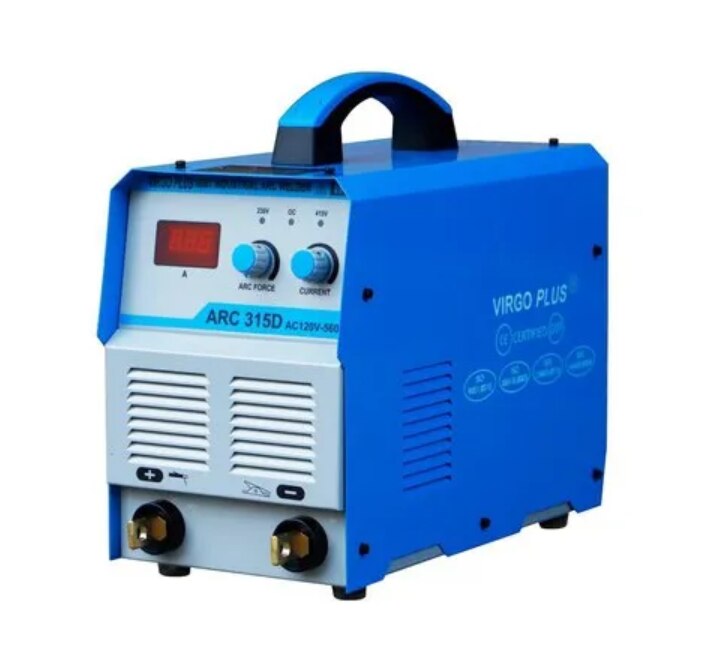 | Welding Machine Minimum Order Quantity 2 Piece Phase Single Welding Type Arc Brand Esab Model 315 AP Insulation A Compatible Rods 8 mm Established in the year 2020... View product → |
 | Walk Behind Roller Minimum Order Quantity 5 Piece Engine Power 5 HP Drive type Manual Rolling Width 1675 mm, 1250 mm Max Roll Weight 330 Kg Approx. View product → |
 | Inverter Submerged Arc Series Welder Inverter Submerged Arc Series Welder Output Current 200 Amp Phase 3 Phase Automation Grade Automatic Power Source Electric Usage Welding Material MS Model Number Virgo Plus Established... View product → |