
The lowest quoted price for an HDPE liner can conceal missing thickness data, weak traceability, unsuitable welding support, or site conditions that puncture the sheet. By the end, you will be able to calculate the material quantity, set a defensible specification, inspect delivered rolls, compare alternatives, and assign installation responsibilities before placing an order.
Key takeaways
- Measure slopes, upstands, trenches, overlaps, and repair waste before requesting prices.
- Match HDPE thickness and material to water, soil, exposure, and installation conditions.
- Remove sharp stones and compact the subgrade before laying the liner.
- Require roll traceability, seam testing, penetration details, and clear installation responsibility.
Calculate the liner quantity before comparing supplier prices
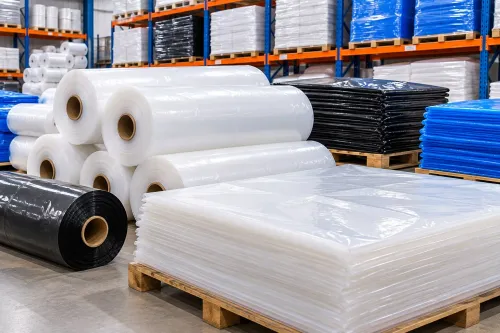
A water-surface measurement is not a liner area calculation. Price an HDPE pond liner sheets supplier only after measuring the floor, side slopes, perimeter upstands, anchoring trench dimensions, overlaps, and expected repair waste.
1. Measure each pond section separately. For a rectangular pond, calculate each side-slope length as √(vertical depth² + horizontal run²). Add the two slope lengths and the anchoring allowance to the floor length; repeat the calculation across the width. For irregular ponds, divide the plan into rectangles, trapezoids, and triangles, then total their developed surfaces.
2. Convert the layout into panels. Add the specified welding overlap to every panel edge; a 150 mm overlap, for example, adds 0.15 m wherever two sheets meet. Include the liner run down the trench wall and across its base, using the actual trench width and depth rather than a nominal perimeter allowance.
3. Add repair waste after calculating the panel total. Use 5% for a simple, accessible layout and 10% where the pond has many corners, penetrations, steep slopes, or difficult handling. Round the result up to complete rolls, not merely to the nearest square metre.
Give the supplier a panel schedule showing finished dimensions, overlap zones, trench returns, total area, and roll lengths. Ask for roll weights and handling limits before choosing wider rolls: fewer seams save welding time, but heavier rolls increase unloading and damage risk.
Choose thickness and material for the actual service conditions
A 5 mm HDPE sheet is suitable for severe service: deep reservoirs, containment areas with high static loads, exposed edges, or sites where maintenance traffic and handling create extra puncture risk. It is not automatically the best fish pond liner; the thick sheet costs more, weighs more, and requires more demanding welding and deployment.
| Option | Suitable service | Main caution |
|---|---|---|
| 5 mm HDPE | Heavy-duty containment, deep irrigation reservoirs, high-load farm storage tank liner applications | Needs a smooth, protected subgrade; stiffness complicates folds and penetrations |
| 1.5 to 3 mm HDPE | Fish ponds, irrigation reservoir liner projects, canals, and ordinary water storage | Increase thickness when settlement, rock exposure, or access loads raise puncture risk |
| PVC or EPDM | Curved tanks, awkward penetrations, or applications needing greater flexibility | Confirm chemical, ultraviolet, temperature, and water-use compatibility before selection |
Choose the HDPE liner thickness with the cushion, cover, water depth, slope, and expected settlement. Sharp stones and point loads can puncture 5 mm HDPE, so thickness cannot replace geotextile protection or proper grading.
Do not buy on nominal thickness alone. Require the specified minimum or average thickness, tolerance, thickness-test method, and certificate values. Ask for a named specification such as GRI GM13, including its stated test methods and revision.
Use another lining material when flexibility, chemical resistance, or compatibility with fish, drinking water, or stored liquid controls the decision. Check the permit and contained liquid before accepting a commercial pond-liner grade.
Prepare the ground so the liner is not punctured or overstressed
The subgrade, not the HDPE sheet alone, determines whether stones, settlement, or trapped water cause failure. Strip roots, topsoil, rubble, and sharp stone removal from the pond footprint, then compact a smooth soil or fine-grained subgrade without leaving ruts or soft pockets.
Match the protection and drainage system to the ground condition:
| Control | What to provide | Failure prevented |
|---|---|---|
| Soft or variable soil | Remove weak zones and compact engineered fill in layers | Differential settlement and panel stretching |
| Rocky or debris-filled soil | Geotextile underlay, soil cover, or a geocomposite cushion | Punctures from point loading |
| Seepage or rising groundwater | Pond liner drainage beneath the liner, with outlets or a designed leak-detection layer | Uplift, bubbling, and trapped water |
| Steep or erodible banks | Benching, compacted layers, surface-water diversion, and slope stabilisation | Slips that drag or tear the liner |
| Hot, exposed deployment | Anchor trenches, controlled panel placement, and wrinkle management | Thermal contraction stress and folded seams |
Extend underlay across the floor, side slopes, and anchor trench; do not leave exposed gaps at transitions. Design drainage before installation, because adding it after the liner is covered requires excavation.
Grade slopes consistently and round sharp crest and toe transitions. Do not stretch panels tight across them. Deploy HDPE during a stable temperature period, weld after excessive heat wrinkles relax, and secure the perimeter while allowing thermal contraction.
A covered liner also needs enough soil or ballast to prevent wind uplift without creating new point loads.
Demand measurable sheet quality and roll-level traceability
A roll labelled “HDPE” proves only its polymer family, not its construction quality. Specify GRI-GM13, name the applicable revision and test methods, and require a certificate of analysis for the delivered production lot.
Ask for these records and release checks:
- The resin or production-lot number, roll number, manufacturing date, width, length, nominal thickness, specified minimum or average thickness, thickness-test method, and thickness tolerance.
- Test results for density, tensile strength and elongation, tear resistance, puncture resistance, carbon black content, and carbon black dispersion. GRI-GM13 targets approximately 2–3% carbon black; poor dispersion creates weak spots and reduces UV protection.
- Standard oxidative induction time results, with the test temperature and method identified. OIT screens antioxidant stability; it does not predict service life under your pond’s UV exposure, temperature, chemicals, stress, or welding history.
- A retained sample linked to each roll, so the installed panels can be traced to tested material rather than a generic datasheet.
- At delivery, inspect every roll for punctures, cuts, brittle or contaminated areas, crushed edges, width and length, visible thickness variation, readable labels, and intact packaging. Record photographs and quarantine discrepancies before unloading into storage.
- If joining is included, request documented trial welds, calibrated equipment records, operator qualifications, non-destructive testing, and destructive seam-test frequency under GRI-GM19.
RELIABLE IMPEX can be evaluated on the same evidence: compare its quoted pond liner against these roll-level records, not against a black-sheet description or a nominal thickness alone.
Related product
 | Hdpe Pond Liner Minimum Order Quantity 100 Square Meter Material HDPE Size 6 FT x 12 FT Usage/Application Water Storage Color Black Thickness 5 mm Is It Waterproof... View product → |
Make welding, penetrations, testing, and responsibility part of the purchase
A low sheet price is meaningless if the quote leaves field work undefined. Require the supplier to separate HDPE material supply from installation, quality assurance, and warranty responsibility.
Specify who owns each item:
- Panel layout, roll identification, deployment, anchorage trenches, and treatment of wrinkles caused by temperature changes
- Hot-wedge welding for double-track fusion seams and extrusion welding for single-track details, patches, and penetrations
- Pipe boots, flanges, prefabricated fittings, and sealing around every inlet, outlet, overflow, and anchor point
- Trial welds, calibrated equipment, qualified operators, seam logs, and as-built drawings
- Non-destructive testing, destructive-test frequency, failed-test repairs, retesting, and final acceptance
- Protection of the liner during backfilling, cover placement, and later construction
State the acceptance criteria, not just “weldable material.” Require seam peel and shear results under ASTM D6392 or the project specification; sheet tensile strength alone does not prove seam reliability.
Reject the phrase ASTM D5820 vacuum-box testing. ASTM D5820 covers pressurized air-channel testing for double-track seams with an enclosed channel. Single-track extrusion welds need another method, such as vacuum-box testing, with the test vacuum, dwell time, and pass/fail criteria written into the quote.
Make repairs the installer’s cost when a seam fails inspection. Also state who supplies approved repair patches and who signs the completed test records. A warranty that excludes workmanship, penetrations, or failed retesting provides little protection.
Frequently asked questions
How do you calculate the quantity of HDPE pond liner needed?
Measure the pond floor, side slopes, perimeter upstands, anchoring trench dimensions, overlaps, and expected repair waste rather than using water-surface area alone.
How do you choose HDPE pond liner thickness?
Match thickness and material to the pond’s water load, subgrade condition, exposure, installation method, and risk of puncture or overstressing.
How should the ground be prepared before installing an HDPE pond liner?
Remove sharp stones and debris, shape and compact the subgrade, and prepare stable slopes, perimeter upstands, and anchoring trenches.
What quality records should an HDPE pond liner supplier provide?
Request measurable sheet-quality information, roll-level traceability, welding records, penetration details, seam-test results, and defined responsibility for installation defects.